There’s usually a faster way to get there.
A wider highway. A more direct route. A navigation app promising to save another twelve minutes.
And sometimes, that’s exactly what we need.
But every once in a while, there’s another option: the road that follows the mountains instead of cutting around them. The one that winds beside a lake, passes through small towns, or disappears into a forest for miles at a time.
It might take longer.
That’s kind of the point.
Taking the scenic route reminds us that travel doesn’t always have to be about reaching somewhere as quickly as possible. Sometimes the road itself deserves to be part of the experience.
1. The Journey Becomes Part of the Destination
Most trips begin with a destination.
A campground.
A national park.
A cabin.
A mountain town.
A place we’ve been waiting to visit.
It’s easy to treat everything between home and that destination as something to get through.
But a road trip can be different.
When you choose a slower, more interesting route, the journey becomes part of what you came for.
Suddenly, the mountain pass matters.
The roadside overlook matters.
The small town you’ve never heard of matters.
You’re no longer simply traveling toward an experience.
You’re already having one.
2. Scenic Roads Encourage Us to Slow Down
Modern travel is remarkably efficient.
We can calculate the fastest route, estimate arrival times, avoid traffic, and optimize almost every mile of a journey.
That convenience is useful.
But efficiency isn’t always the same thing as enjoyment.
Scenic travel gives you permission to stop measuring a trip entirely by how quickly you arrive.
Maybe the road is slower because it curves through the mountains.
Maybe you stop for twenty minutes because the view is too good to pass.
Maybe lunch takes longer because you find a picnic spot beside the water.
Nothing went wrong.
You simply stopped rushing.
3. Unexpected Stops Often Become the Best Memories
Some of the most memorable road-trip moments were probably never on the itinerary.
A roadside fruit stand.
An old gas station.
A tiny diner.
A strange local attraction.
A trailhead you noticed while driving past.
A viewpoint with no one else around.
A sunset that convinced you to stop the car.
These moments are difficult to schedule because you don’t know they exist until you find them.
That’s part of what makes them special.
Leaving some flexibility in your trip creates room for curiosity.
And curiosity has a funny way of finding good stories.
4. You Notice More When You Travel Slowly
Take the interstate and the landscape can become something happening outside the window.
Take a smaller road and you begin noticing details.
The way the trees change as you climb higher.
Old barns beside the road.
Mountains slowly appearing in the distance.
Signs for towns you’ve never visited.
Rivers following the highway.
Local cafés.
Fields.
Bridges.
Wildflowers.
Weather moving across the horizon.
The scenery stops being background.
It becomes part of the trip.
5. Road Trips Make Simple Things Feel Special
A cup of coffee at home is ordinary.
A cup of coffee at a roadside overlook with mountains in the distance?
That feels different.
The same thing happens with simple road-trip moments.
Eating sandwiches from the back of the car.
Listening to music with the windows down.
Stopping somewhere just to stretch your legs.
Looking at a paper map.
Watching the landscape change over several hours.
These aren’t extraordinary activities.
But put them in the middle of a journey and they somehow become memorable.
Road trips have a way of turning ordinary moments into part of the adventure.
6. The Right Playlist Changes Everything
Every good road trip eventually develops a soundtrack.
Some songs are perfect for long highways.
Others belong on mountain roads.
And occasionally a song plays at exactly the right moment—the sun is setting, the road opens ahead, and suddenly the whole scene feels like it was arranged for that track.
Music can become connected to travel memories surprisingly quickly.
Months or even years later, hearing the same song can bring you back to a particular stretch of road.
So before your next trip, make a playlist.
Then leave enough room for a few songs you haven’t heard before.
You never know which one will become part of the memory.
7. You Don’t Always Need a Big Destination
Not every road trip needs to end at a famous landmark.
Sometimes the trip itself can be the plan.
Choose a direction.
Find a small town you haven’t visited.
Drive toward the mountains.
Explore a nearby lake.
Visit a state park.
Find a local restaurant somewhere outside your normal routine.
Then take a different road home.
A short day trip can still provide the feeling of getting away without requiring weeks of planning.
Adventure doesn’t always have to be far away.
Sometimes it’s sitting a couple of exits beyond the places you normally go.
8. Scenic Routes and Outdoor Adventure Naturally Belong Together
If you enjoy camping, hiking, mountains, forests, or van life, scenic roads often connect the experiences you love.
The drive to a campsite becomes part of the camping trip.
The road through the mountains becomes part of the hike.
The route beside the lake becomes part of the weekend.
And for van travelers, the distinction between road trip and destination can become even smaller.
One adventure flows naturally into the next.
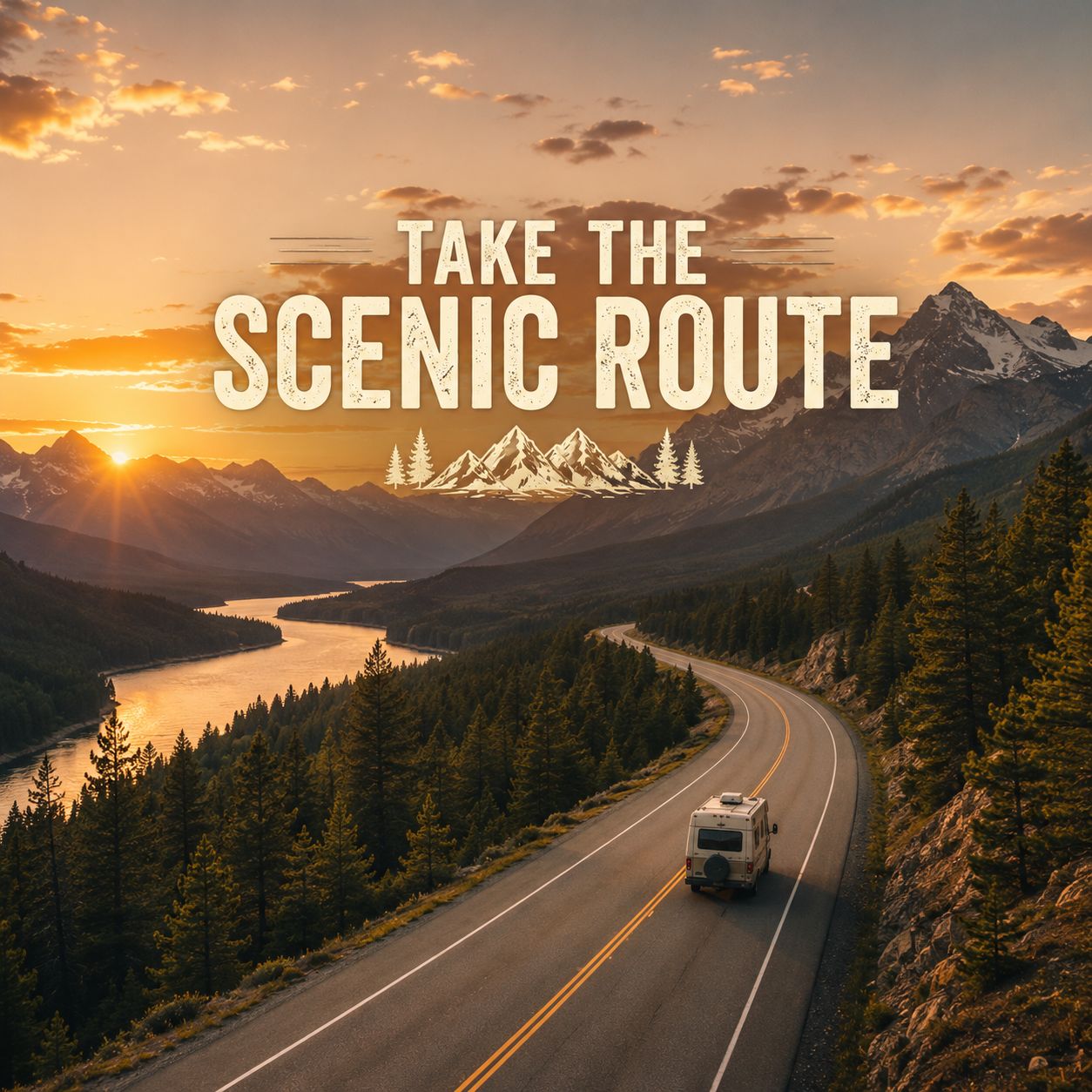
That’s why imagery like winding roads, camper vans, mountains, forests, maps, and sunsets has become so closely connected with outdoor culture.
They all represent the same idea:
There’s more out there to explore.
9. Taking the Scenic Route Doesn’t Mean Ignoring the Practical Stuff
Spontaneity makes road trips fun, but preparation still matters.
Before choosing a less familiar route, consider current road conditions, weather, fuel availability, seasonal closures, vehicle suitability, and whether you’ll have reliable phone service.
Download maps for areas where coverage may be limited and keep basic supplies in your vehicle.
If you’re heading into remote areas, make sure someone knows your general plans when appropriate.
A little preparation gives you more freedom to enjoy the journey without turning an unnecessary problem into part of the adventure.
10. Leave Room in the Schedule
One of the easiest ways to ruin a scenic road trip is to create a schedule that leaves no time for scenery.
If every stop puts you “behind,” you’ll spend the entire journey watching the clock.
Instead, build some flexibility into your plans.
Give yourself time for viewpoints.
Coffee stops.
Short walks.
Photographs.
Unexpected detours.
Or simply sitting somewhere beautiful for a little longer than necessary.
You don’t need to stop everywhere.
You just need enough time to stop when somewhere feels worth it.
11. Sometimes Getting a Little Lost Is Part of the Story
There’s a difference between being dangerously lost and simply taking a road you didn’t originally plan to take.
The second kind can occasionally be wonderful.
Maybe you miss a turn and discover another route.
Maybe you see a sign that sounds interesting and decide to follow it.
Maybe the road looks promising enough to make you curious about where it goes.
Responsible travel still matters, especially in unfamiliar or remote areas.
But not every deviation from the plan is a mistake.
Sometimes the best direction is the one you didn’t expect.
12. Every Mile Can Hold a Memory
When we think about a trip afterward, we often remember more than the destination.
We remember who was sitting beside us.
What we were listening to.
Where we stopped for breakfast.
The terrible gas-station coffee.
The weather.
The jokes.
The view from the passenger window.
The road that seemed to go on forever.
The sunset near the end of the day.
These little moments accumulate mile after mile.
Eventually, the road itself becomes part of the memory.
Take the Road That Gives You Something to Remember
There will always be times when the fastest route is the right route.
But when you have a little extra time, consider choosing the road with more curves.
The one through the forest.
The one beside the lake.
The one that crosses the mountains.
The one that gives you a reason to stop.
You might arrive a little later.
You might use a little more fuel.
You might discover somewhere that wasn’t part of the original plan.
And that’s okay.
Because not every journey needs to be optimized.
Some are better when they’re simply enjoyed.
So pack what you need, choose a good playlist, leave some room in the schedule, and follow the road that looks a little more interesting.
Sometimes the scenic route is the destination.